Showing posts with label emergency. Show all posts

Monday, April 13, 2009

The Virtue of Powdered Milk

Ok, I admit it. I used to hate powdered milk as a kid. But I have to admit, it's come a long ways in 30 years, thank goodness. With the cost of milk nowadays, if you've got more than 2 mouths to feed, it can cost as much for milk as it does to fill up your car with gas. And if you're a "dairy freak" like I am, you'll wonder what in the world you'll do in the event of an emergency when you may be FORCED to use powdered milk regularly.

Other than the fact that I always type the word “powdered” incorrectly, I truly do value this storage staple. It will indulge my every dairy craving in a pinch, including buttermilk, cream cheese, sour cream, yogurt, and cottage cheese. Just a little bit of culturing and it turns into whatever dairy product I desire. In fact, I can even combine it with an equal amount of ice water and some flavoring and turn it into a yummy fluffy dessert topping. And it’s great in all of my recipes. It costs half as much as “fresh” milk, has zero cholesterol, zero fat, and is high in calcium, vitamin D and protein. And hey, it even comes in an easy to store box which I can neatly stack on my shelves. I have found no problem using it as a milk substitute in every recipe with just a bit of water added to it. I can also make dry baked mixes or beverage mixes ahead of time with it with no need for anything else but water. Ironically, the only thing I don’t care for powdered milk is as a substitute for just plain milk. However, I have discovered the trick of adding in a ½ teaspoon of vanilla per half gallon of powdered milk mixture to make it taste a lot better. I find that powdered milk tastes just fine when mixed equally with whole milk as well. Plus, I’ve never had kids complain when I mix chocolate syrup or strawberry syrup in it straight.

Powdered milk tastes best if it is mixed up and allowed to chill overnight before serving, or for at least 4 hours. Chilling actually aids in dissolving the powdered milk completely and gives it a fresher flavor.

OK. To use powdered milk for just about anything, you first need to learn to reconstitute it. So let’s start with that.

Reconstituted Powdered Milk:
Take a 2 quart pitcher and fill it just over half with very cold tap water. Then add 2 and 2/3 cup of powdered milk. Using a long whisk, whisk the milk until it appears to be well mixed and the milk appears to be mostly dissolved. Then fill the pitcher to full with additional cold water. It’s best to have a lid on the pitcher and then place it in the refrigerator overnight or at least 4 hours.

To make buttermilk from reconstituted milk, you’re going to need some “starter.” But don’t worry. You can buy the small pints of buttermilk and store them in your freezer until you’re ready to use them.

Cultured Buttermilk: You won’t believe how easy this is! Take 3 and ¾ cups of reconstituted milk and add it to ½ cup of commercial buttermilk. Allow it to sit on the counter overnight (8 to 10 hours at room temperature) and Voila! You’ve got buttermilk! (I store it refrigerated thereafter, just so you know.) I have to have buttermilk to make my all time favorite syrup recipe (Sorry, I’m going to save that for another post).

Here’s another idea that I have loved to use with powdered milk. It’s called “molasses milk.” All you do is warm up about ¾ cup of reconstituted milk and then stir in a regular spoonful of molasses (double and triple accordingly). It’s yummy. It kind of tastes like caramel toffee. And here you thought that molasses was just for cookies.

Hopefully from reading this you’ve thought about the importance of having powdered milk in your supplies, along with molasses, chocolate syrup, and vanilla extract in your storage items. For future reference I would also add that you’ll want lemon juice and cocoa as well.

I look forward to sharing more with you later.

Copyright 2009 Kellene Bishop. All rights reserved.
You are welcome to repost this information so long as it is credited to Kellene Bishop.

Preparedness Pro Note: If you would like Kellene Bishop to present an Emergency Preparedness message for your community or church group, please contact us at 801-788-4133. Ms. Bishop is an experienced speaker on Emergency Preparedness topics and also has created a great “Preparedness Party” platform which makes the learning of such a topic more enjoyable for all.

Friday, February 13, 2009

The Magic Number 12

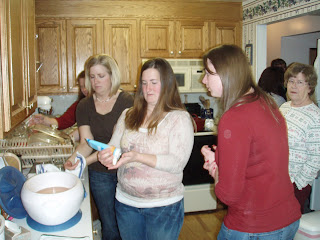
Friday before last I decided to throw a party at my home. I wanted it to be an enjoyable night for the girlfriends in my life, so I threw in some paraffin hand treatments and made tons of food from my food storage supplies. We had 3 main dishes, 2 side dishes, an appetizer and 2 desserts. Would you believe, the food disappeared rapidly with countless requests for recipes?

After everyone had enjoyed their fill of yummy food – yes, I did say “yummy” and yes, it was all made from what I had on hand – we then all sat down and discussed the 9 key areas of emergency preparedness. So many additional ideas and insights were added to my own and we all benefited substantially. So in addition to sharing the recipes with all of my blog readers, I’m also going to break down various components that were discussed for practical application in your emergency preparedness activities. So here’s a great tip followed by a recipe of ingredients from your food storage:

The Magic Number 12

This is a great tip for novices and pros alike when it comes to accumulating your food storage. As I’ve shared previously, it’s important to “store what you eat and know how to prepare what you store.” This particular tip addresses an effective way to store what you eat.

The other day I was reading a cookbook — I do that frequently — and I happened upon a recipe that I realized I could adapt to make from cans, jars, and food storage items. So I purchased the items from the grocery, tested the recipe out on my hubby, and discovered we had a new yummy recipe that he would eat for a nice dinner, let alone in an emergency situation (He assures me that he won’t be as picky of an eater in an emergency as he is now…but I’m not planning on counting on that promise). So I watched the coupons and ads for the local grocery stores and then went out and purchased enough ingredients to make that dish 12 times. Why?

The objective is to store a year’s supply of food storage, right? I’m also sensitive to avoiding “appetite fatigue” and ensuring that my husband actually enjoys the meals I create. In an emergency, it’s not likely that you will be cooking 3 meals a day, rather one meal of substance, and the rest would be meals of convenience such as instant oats, cold cereal, peanut butter and jelly, canned chicken on crackers, etc. As long as you have a plan for one main meal every day, then you’ll be far ahead. To recap, if you have 30 different meals in your repertoire each month, then you are likely to not meet any appetite fatigue issues or stress because you’re attempting to introduce something new to your family when they are already under a great deal of stress as the result of an emergency.

This is why I purchase my grocery items in increments of twelve. If 12 is too much to handle due to space or financial restraints, then take it down to 6 or 4 or 3. But if you get yourself in the habit of buying this way when you have a recipe that works for you and your family, you will have your year’s supply of meals in a short period of time. Now that’s what I call “eating the elephant one bite at a time.”

Here’s one of the recipe’s which I created for this event. It’s just an open, dump, stir, and warm kind of recipe. Thus not only does it use a minimal amount of your physical energy, it will require a minimal amount of precious fuel as well to warm up.

Southern Chicken and Wild Rice Casserole

4 cups of canned chicken, drained
1 package (6 ounces) of Uncle Ben’s Long Grain and Wild Rice Original Recipe
1 can of cream of celery soup
2/3 cup of Miracle Whip (don’t substitute any different mayonnaise)
1 can (8 oz) of diced water chestnuts, drained (I like to chop mine a bit smaller than they come in the “diced” can)
1 2 oz. jar of sliced pimento peppers. (diced is fine also)
1 regular sized can of French cut green beans, drained
1 ½ cups of chicken broth OR water
2 Tablespoons of pre-grated Parmesan cheese (the stuff in the green can is just fine.)

Combine all of the ingredients in a mixing bowl and mix well with a spoon. Transfer to a Dutch oven, or a pre-greased baking dish if you’re cooking in a solar oven. Top the dish with the Parmesan Cheese. If using a solar oven, be sure to cover the dish with foil. If using the Dutch Oven, simply put on the lid.

Bake at 400 degrees for 25 to 30 minutes until it’s bubbling and the rice has cooked. Let cool about 5 minutes and then serve.

You can also cook this most expeditiously and economically in a pressure cooker. Simply bring the cooker to full pressure with the ingredients mixed together inside, then once it’s come to full pressure, remove from heat, wrap in towels and continue to cook for about 15 minutes.

Enjoy! Let me know what you think!

Copyright 2009 Kellene Bishop. All rights reserved. You are welcome to repost this information so long as it is credited to Kellene Bishop.


Preparedness Pro Note: If you would like Kellene Bishop to present an Emergency Preparedness message for your community or church group, please contact us at 801-788-4133. Ms. Bishop is an experienced speaker on Emergency Preparedness topics and also has created a great “Preparedness Party” platform which makes the learning of such a topic more enjoyable for all.

Tuesday, January 20, 2009

Are You Living With a False Sense of Security?

Here’s a reality question. Do you really have sufficient food and water storage for one year? Recently information was revealed that the majority of a large nationwide mix of individuals who thought they had a year’s supply of food for their family, actually only had 90 days! And of the individuals who thought they had a years supply of water only had 3 weeks! Wow. Talk about a false sense of security, eh? (Let’s at least hope that the situation has been remedied since the results of the analysis.)

In my opinion, what’s more disturbing though is the vast majority of individuals who know…really know…that they need to store a years supply of food, water, and other necessary emergency supplies but who have not even begun. It reminds me of the joke of the guy who’s stranded on the top of his roof due to flood waters.

The man prays and prays for the Lord to spare him. Interrupting his prayers was a man in a small life raft, offering the man safe passage. The praying man waved the life raft on, assuring the would-be rescuer that he would be just fine. The man continues to pray for help. Shortly thereafter a helicopter arrives to take the man from his roof. The man waves the helicopter on convinced that the Lord would spare him in answer to his prayers. Finally, the flood waters rise enough to drown the man. As he’s standing before the Lord he asks Him why He didn’t answer his prayers? Naturally the Lord responds that He did indeed send the life raft and the helicopter.
Are we ignoring the life rafts and helicopters? Have we as a nation not had sufficient warning that we need to be more prepared for the disasters in our life? Do we need to be subjected first hand to a tsunami, the Teton Dam breaking, an earthquake, a debilitating ice storm, or a ferocious hurricane before we wake up and truly prepare? Is there really any fact-based doubt in anyone’s mind that we need to take responsibility for our own well-being in the midst of a calamity?

Recently my local electric company and gas company officials were questioned as to their availability for a restitution of power and gas should there be a major disaster. The gas company informed us that they had 30 employees to take care of over 450,000 homes. The power company informed us that they had only 4 backhoes to take care of that many homes as well. In other words, there is not going to be a quick fix in the event of a true catastrophe. No matter how much we pay them, our demands for a restitution of service will go unheard. It’s simply a matter of fact.

My neighbor is a fireman. A relatively close neighbor is a surgeon. And yet another is a National Guardsman. But does this mean that these individuals will be on hand for their neighbors should there be a catastrophe? Nope. Sorry. These individuals will be doing what they are trained to be doing…and doing it elsewhere. Heck. They are hardly ever home with things are going well, let alone when there’s a disaster.

4 in 100 families who religiously believe in a doomsday scenario are appropriately prepared with a years supply of necessary items. Needless to say, those are some awful statistics—and this is among those who are religiously convinced individuals. What about the rest of society that simply doesn’t care or take time to think about such preparedness? A lot of lives will be unnecessarily lost and a lot of hearts will be unnecessarily burdened if we do not take care of our needs for tomorrow, today.

May we all take a solemn responsibility for our well-being that we may be in a position to help others who are truly in need when times get really, really tough.

Kellene

Copyright 2009 Kellene Bishop. All rights reserved. You are welcome to repost this information so long as it is credited to Kellene Bishop.


Preparedness Pro Note: If you would like Kellene Bishop to present an Emergency Preparedness message for your community or church group, please contact us at 801-788-4133. Ms. Bishop is an experienced speaker on Emergency Preparedness topics and also has created a great “Preparedness Party” platform which makes the learning of such a topic more enjoyable for all.

Wednesday, January 14, 2009

Will Your Wheat Storage Kill You? Exploring the utilization of wheat in your food storage

When most people think about eating from their food storage, they think about mundane wheat, rice, and beans. If I had to live on that, I may very well starve to death out of boredom, also known as “appetite fatigue.” There are two key ways to avoid this from happening to you and your family if you’re forced to live off of food storage.

1) Store what you eat
2) Learn to use what you store

While this may sound simple, I find that frequently when I evaluate a person’s food storage they are storing items which they have no idea how to convert into an edible food and in some cases they are even storing items which they are allergic to!

Here are the facts. If you attempt to go from what you’re eating every day now to surviving off of whole wheat, you will be dead within 3 months from the shock of what the wheat will do to your digestive system. If you intend to use wheat in an emergency, you better begin acclimating your body to wheat right now. (It’s the only reason why I learned to make bread, but boy are my husband and father-in-law glad I did. They love my bread!)

So introducing wheat into your diet on a daily basis now is one way to avoid shocking your system literally to death. And it’s part of the fundamental of “learning to use what you store.” I’ve had one woman show me her ample supplies to make some wonderful sounding dishes, but she’s never attempted to make them for herself or her family. That’s a catastrophe waiting to happen.

Remember, the time for preparation is over when the opportunity (or disaster) appears.

Another way to prevent a system shock when you’re forced to convert your lifestyle as the result of an emergency is to store items such as Kamut, Amarath, Quinoa, Millet, and Spelt. These types of grains mixed in generously with wheat will prevent the negative effects of shocking your body with straight wheat. Oh, and by the way, be sure you learn how to eat these items as well. (Yes, you can sprout them also).

Given the choices though, I prefer to introduce wheat into my body regularly. The reason being is that the other grain choices above are 4 to 10 times more expensive than wheat. And that’s saying a lot considering how much wheat has gone up in pricing over the last 2 years.

Learning to use what you store also requires a level of awareness. As you use recipes in your regular meal making activities, ask yourself if you have the items necessary to create such a meal with what you’ve got in storage (This includes what you may need to actually cook the meal with such as a Dutch Oven, Solar Oven, alternatively fueled stoves, etc. I frequently use my Joy Cook stoves for testing emergency preparedness recipes. They are made in Korea and I always see them being sold at sporting goods stores as well as trade shows for camping, boating and guns).

I also specifically look for recipes in which I can adapt the items easily, or already stock in my food storage. For example, today I played around with using peanut butter, ginger vinaigrette and fettuccine. It turned out nicely. But then again I like Thai flavored types of food as well. My husband on the other hand… not so much. Back to the drawing board for me on that one, I guess.

Here is the recipe for you to test out on your finicky eaters:

Ginger Peanut Fettuccine
1 box of (8 oz.) of fettuccine
½ cup of peanut butter (crunchy is ideal for this recipe)
¾ cup of ginger vinaigrette dressing
1 tablespoon of minced garlic. (I buy mine by the large jar and use it all year round)
Reserve 1 ¼ cup of the pasta water

Cook fettuccine according to box directions. Drain completely, setting aside the reserved pasta water. Set aside your pasta while you make the sauce. Returning your pan to the hot surface, simply add your garlic, dressing, peanut butter and pasta water, stirring until smooth. Add cooked pasta. Stir well until mixed.
Makes four servings which include necessary fats, proteins, and carbohydrates. I like to sprinkle a bit of dried parsley over each serving as well.

Enjoy!

I’ll address more of the fundamental of “storing what you eat” in future blogs.

Kellene

Copyright 2009 Kellene Bishop. All rights reserved. You are welcome to repost this information so long as it is credited to Kellene Bishop.


Preparedness Pro Note: If you would like Kellene Bishop to present an Emergency Preparedness message for your community or church group, please contact us at 801-788-4133. Ms. Bishop is an experienced speaker on Emergency Preparedness topics and also has created a great “Preparedness Party” platform which makes the learning of such a topic more enjoyable for all.

Friday, January 9, 2009

Seeds of Preparedness

Many individuals I speak with about emergency preparedness are concerned of the cost of getting prepared and the amount of space they have to store everything. Today’s blog is just one way you can be successful at improving your state of preparedness without being paralyzed by cost or space.

In the fall, garden seeds are typically marked down dramatically. Are these safe to buy and store without immediately planting them in the ground? Well, usually, the answer is yes. I’ll clarify in a moment. Obviously, paying 70% off the original price of seeds is a bargain most can’t walk away from, and the space necessary to store seeds isn’t cumbersome even in a New York City apartment.

So how do you know when the seeds you buy off-season are going to do you any good in years to come, you ask? Ask the store supervisors how the seeds were stored. If they were displayed all summer out in the hot sun, then you’ll need to move on to another bargain. However, if they were stored in the store, or in the store greenhouse area the majority of the time, then you can be safe to purchase and store them for at least another 5 to 10 years. Even better is if you can store them individually packaged but in a larger container to prolong freshness. The key is for you to store them in a cool, dark and dry place. It was a way of life for our ancestors – they stored and traveled with seeds regularly. “Hey honey, be sure to grab the kids and the seeds. The mammoth is leaving soon.” Don’t let the modernization of a greenhouse throw you off your instincts.

Seeds are full of great nutrition as sprouts. An added bonus with this practice is if your seeds do sprout, then you know they are good and nutritious. In fact, in some cases, the sprouted seeds are MORE nutritious sprouted than as full grown plants, though perhaps not as enjoyable to eat. So, if you’re in doubt, prior to planting seeds in the typical manner, take a few and sprout them in doors. Sprouting typically involves water, some cheesecloth, and a small mason jar. Think about it – in an emergency, you’re not exactly going to have time to plant your seeds and then wait for the harvest if you’re starving and other food supplies are cut off. Some seeds take only 24 to 48 hours to sprout. As long as you have water (see my last blog) you’ll be able to survive that long without food while you’re waiting for the sprouts to develop.

And while I’m on the topic of sprouts, even though it’s a bit off topic of saving space, dried legumes and wheat grains are EXCELLENT sprouting resources. They are also quite easy to sprout and their nutritional value is dramatically compounded in this state. Additionally, wheat grains and dried legumes store for extremely long periods of time in a cool, dry, dark space, and the sprouting is virtually effortless. (In fact, my husband and I accidentally sprouted some lentils in our basement when we didn’t completely clean up a spill. Some the seeds had fallen down a drain pipe next to the water heater and sprouted soon after with nothing but moisture — no light.)

So I say take advantage of the seed sales you get at the end of the summer and in early fall. They are typically every bit as good and will store quite well. Whether you want edible vegetables and flowers, or showy foliage, go ahead and save a bundle of money! The space you save on “food storage” is great as well.

Copyright 2009 Kellene Bishop. All rights reserved. You are welcome to repost this information so long as it is credited to Kellene Bishop.


Preparedness Pro Note: If you would like Kellene Bishop to present an Emergency Preparedness message for your community or church group, please contact us at 801-788-4133. Ms. Bishop is an experienced speaker on Emergency Preparedness topics and also has created a great “Preparedness Party” platform which makes the learning of such a topic more enjoyable for all.

Friday, December 5, 2008

Water Blogged

Recently I’ve been inundated with requests from readers to know how I’ve personally prepared for the future. These requests have come about as a result of my blog post of Gerald Celente’s economic forecasts (see link here). In fact, I’ve even create an entirely new blog called Preparedness Pro, devoted exclusively to emergency preparedness in the categories of food (including cooking), water, first aid, self-defense, finances, and emotional preparedness. Be sure to add this one to your blogroll and check back often!

What makes me a pro? I’ve been practicing personal preparedness doggedly for over 9 years. Our house has 3 full rooms of necessary emergency supplies. Usually, instead of going to the store, I just go downstairs to our food storage room, grab what I need, and replenish about every 6 months or so. It will be up to you to decide whether or not what I share with you has merit.

First Things First—WATER!

If you have not started preparing for an emergency, do not start with food. Start with WATER! If you’ve already started a sufficient emergency supply food storage, you are probably like the majority of individuals and have put off storing water. “Where am I going to store those ugly barrels?” you ask? Believe me, that’s the last thing you’re going to care about when you need water.

How much water should I store?
You can go without food a heck of a lot longer than you can water. I know this may sound a bit overwhelming, but you really need to store enough water to provide you and your family with 1 gallon per day—minimum—for at least 3 months. Allow me to restate this. 1 gallon per person is MINIMUM. That’s a lot. But you don’t need to go back too far in history to realize that such a need could exist. Think of the hurricanes our nation has had in recent history. Is your area ripe for an earthquake? What if some moron crashes their chemical truck into your water supply?

eep in mind that that one gallon of water is not just for drinking. It’s for hygiene, (and don’t even think that you’ll avoid bathing all together…this will foster serious illnesses, among other things) cooking, toilet use, laundry, and cleaning.

How do I store my water?
Store your water in NEW barrels. Please don’t store water you intend to use for drinking and cooking in barrels that have been used for something else. You will suffer, indeed. (It’s fine to use those kinds of barrels for water you will use exclusively for cleaning, etc.)

Please, please, please do not store your water in empty milk or soda pop bottles. They deteriorate. (Although is you have to choose one of them, pick the soda pop bottles instead. They last a bit longer)

Should I store purified water?
Don’t treat your water before storing it. Chance are very good that it’s already been sufficiently treated by your municipality. Besides, I would recommend treating your water prior to using it for drinking or cooking anyway. To do this you want to use 8 drops of pure Chlorox per gallon of water.

You can fill your water barrels through the garden hose. As long as you let the water run through the hose a bit and there aren’t any bugs sitting in it, you’re fine. Surely you drank out of a hose when you were little and you’re no worse for wear, right?

If you’re a purist, you can purchase a marine hose that is lined with an anti-bacterial coating. Those are readily available at your local hardware store. Keep in mind that the water in your water heater, water bed, and toilet tanks is usable as well.

Iodine tablets, colloidal silver, and quality camping water filters are also a good preparedness step in the event you’re required to use water from sources you’re not familiar with. One of the things that I stock up on as well are the little Xooma water sachets. These small, tea bag like sachets contain minerals and such that can bring your water to a good non-alkaline levels and infuse minerals in them. I personally believe that doing so helps for better hydration to the body. So I keep stocked up on these for an emergency as well. You can check them out at http://www.xoomaworldwide.com/WaterDiva/

How often do I replace the water?
We empty and refill our water barrels every two years. You don’t need to do it that often, but we’re a bit fanatical about things. You’re fine to go out 5 years prior to refilling them as long as it’s good water to begin with. You will want to aerate your water though prior to drinking it. Doing this is as simple as pouring it a few times from one container to another, such as a couple of pitchers.

Where am I supposed to store all this water?
If you’re in a small apartment, you will be pleasantly surprised how easily you can disguise a water barrel as an end table with a small round piece of plywood and a classy decorative tablecloth. We are fortunate enough to have enough space in our basement and have several of them lined up and then have plywood stacked on top of them to begin shelving for our food storage.

Note to wives: If your overzealous husband convinces you to store “an extra” eight 50-gallon barrels under one of the guest beds, you may want to think twice. It’s a family joke now when folks come to stay with us and sleep in the “water bed.”

Don’t buy into the myth that you can’t store your water barrels on cement. Clarification is that you should not store your water on cement that gets heated by the sun. So if you’re storing it outside, the sun will heat the cement, which will then heat your water. This makes water taste nasty. If you’re storing them outside, place the barrels on top of 2 x 4s.

You can store your water barrels outside in freezing weather, but you run the risk of them freezing and cracking. At the very least, you should not fill them up to maximum capacity to allow for the freezing expansion.

Conserving Water
Consider ways to conserve water in an emergency as well. Storing paper goods such as paper plates and cups will eliminate cleaning, and learning to cook with a pressure cooker which uses a minimum amount of water for cooking is also a good idea. (more on pressure cooking in a future blog.)

Copyright 2009 Kellene Bishop. All rights reserved. You are welcome to repost this information so long as it is credited to Kellene Bishop.


Preparedness Pro Note: If you would like Kellene Bishop to present an Emergency Preparedness message for your community or church group, please contact us at 801-788-4133. Ms. Bishop is an experienced speaker on Emergency Preparedness topics and also has created a great “Preparedness Party” platform which makes the learning of such a topic more enjoyable for all.